The quick version
- Through the hatch in the top of the pressure hull.
- Crew steady and guide. They cannot take your weight.
- No lift, no ramp, and none is possible on a pressure hull.
- For anybody who can do it at all, it is unremarkable.
The line that decides who comes
Buried in the practical notes is the condition that decides whether this trip is possible for you at all. Boarding means going down seven steps of a ladder set almost upright, and coming back up the same way at the end, with nobody able to do it for you.
It is stated once, without emphasis, in a list. It is also the single hardest requirement on the trip and the reason a certain number of people cannot do it.
Everything else about this outing is accommodating. There is no swimming, no equipment, no qualification, no pressure change and no physical exertion of any kind once you are seated. The ladder is the entire gate.
Why it cannot be anything else
It is worth explaining rather than simply asserting, because people reasonably ask why a modern vessel cannot manage a gentler entrance.
A submarine is a pressure vessel. Its strength comes from being a continuous curved shell, and every opening in that shell is a weakness that has to be engineered around with a heavy circular hatch and a reinforced frame. The larger the opening, the harder and heavier that problem becomes, so hatches are kept as small as is compatible with a person fitting through them.
A small opening in the top of a hull can only be reached from inside by a ladder, and that ladder can only be near-vertical, because there is no horizontal room to angle it. Anything shallower would need a wider opening and a larger hull penetration.
So the ladder is not a shortcut or an oversight. It is a direct consequence of the boat being able to go to a hundred feet at all, and no amount of engineering changes it.
What independently means
It means under your own power, and the operator is being precise rather than unkind.
Crew are present at the top and the bottom. They will steady you, guide your feet, hold a hand for balance and talk you down. What they cannot do is take your weight, lift you, or carry you, and there is no mechanism aboard that can.
The reason is partly practical and partly about what happens if something goes wrong. A person who cannot climb out unassisted in ordinary conditions cannot climb out in unusual ones either, and a sealed vessel offshore is not a place to discover that.
So the question to ask yourself is not whether you can get down. It is whether you could get back up, unhurried, at the end of an hour and three quarters.
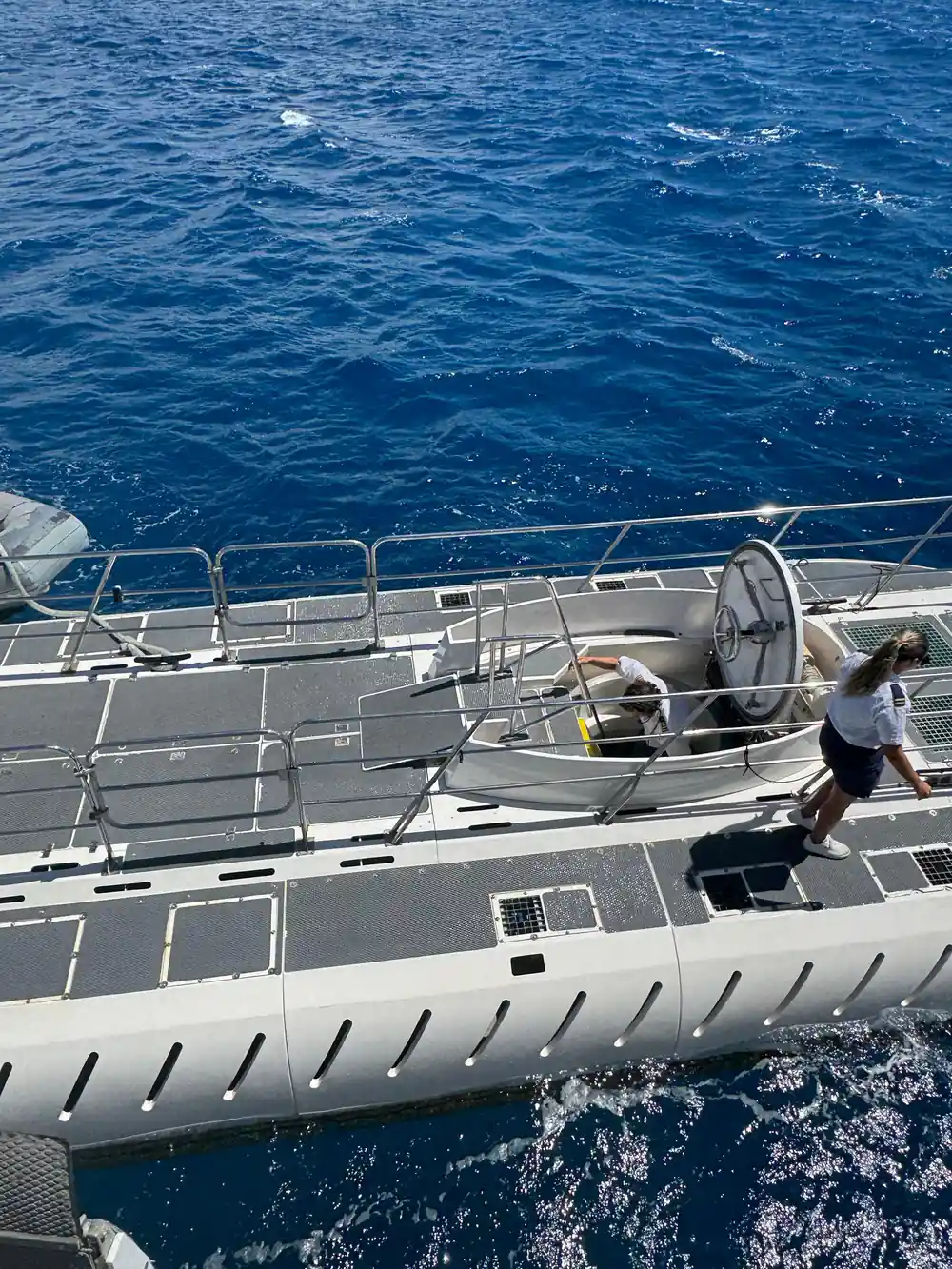
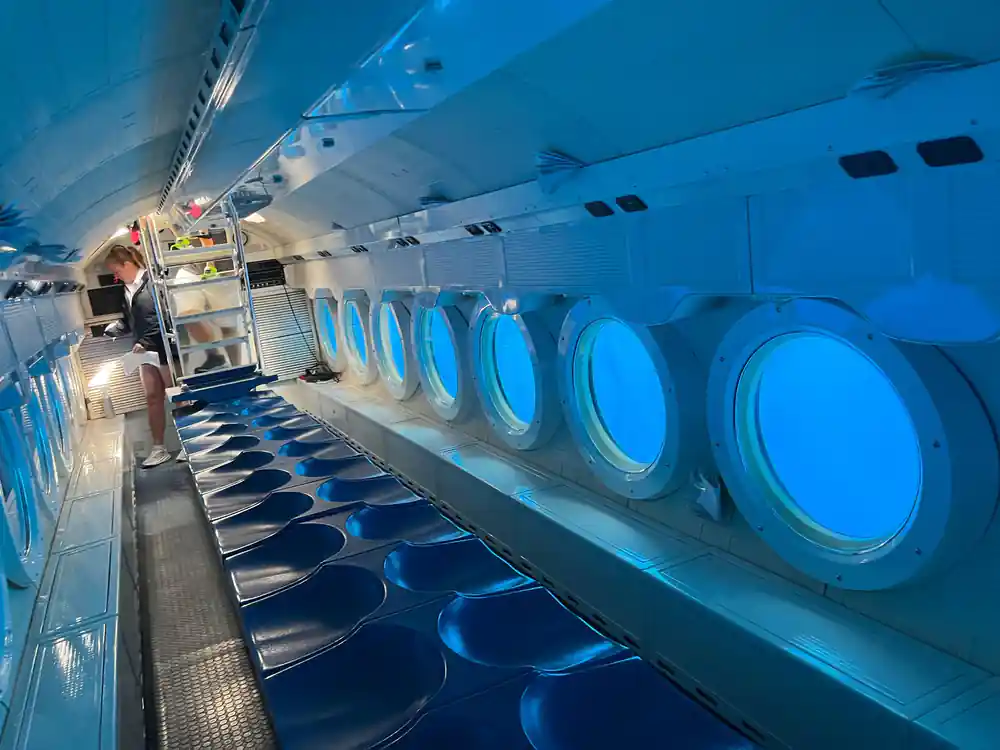
The hatch and the ladder down into the cabin
What it is actually like
For anyone who can do it, it is over in about fifteen seconds and is not memorable.
You face the ladder, as you would a household loft ladder, and go down backwards. Both hands on the rails. Seven steps, one at a time, with somebody talking to you the whole way and somebody waiting at the bottom.
The awkward part is the transition at the top, where you move from standing on a deck to committing your weight to the ladder through a hatch. That is one movement and then it is a ladder like any other.
Coming back up is easier than going down, as it usually is, because you can see where you are going.
What to wear for it
This is the practical reason the operator asks for comfortable shoes, and it is worth taking literally.
Closed shoes with a sole that grips. Trainers are ideal. Flip-flops and backless sandals are a genuinely bad idea on a metal ladder and will be an issue at the transfer between boats as well.
Avoid a long loose skirt or dress, for the obvious practical reasons on a vertical ladder with people below and above you.
Keep your hands free. Anything you are carrying should be in a bag on your back or in a pocket, because both hands belong on the rails.
And if you use a stick or have limited grip strength, this is the point to have a frank conversation with the operator before booking rather than at the hatch.
How boarding works overall
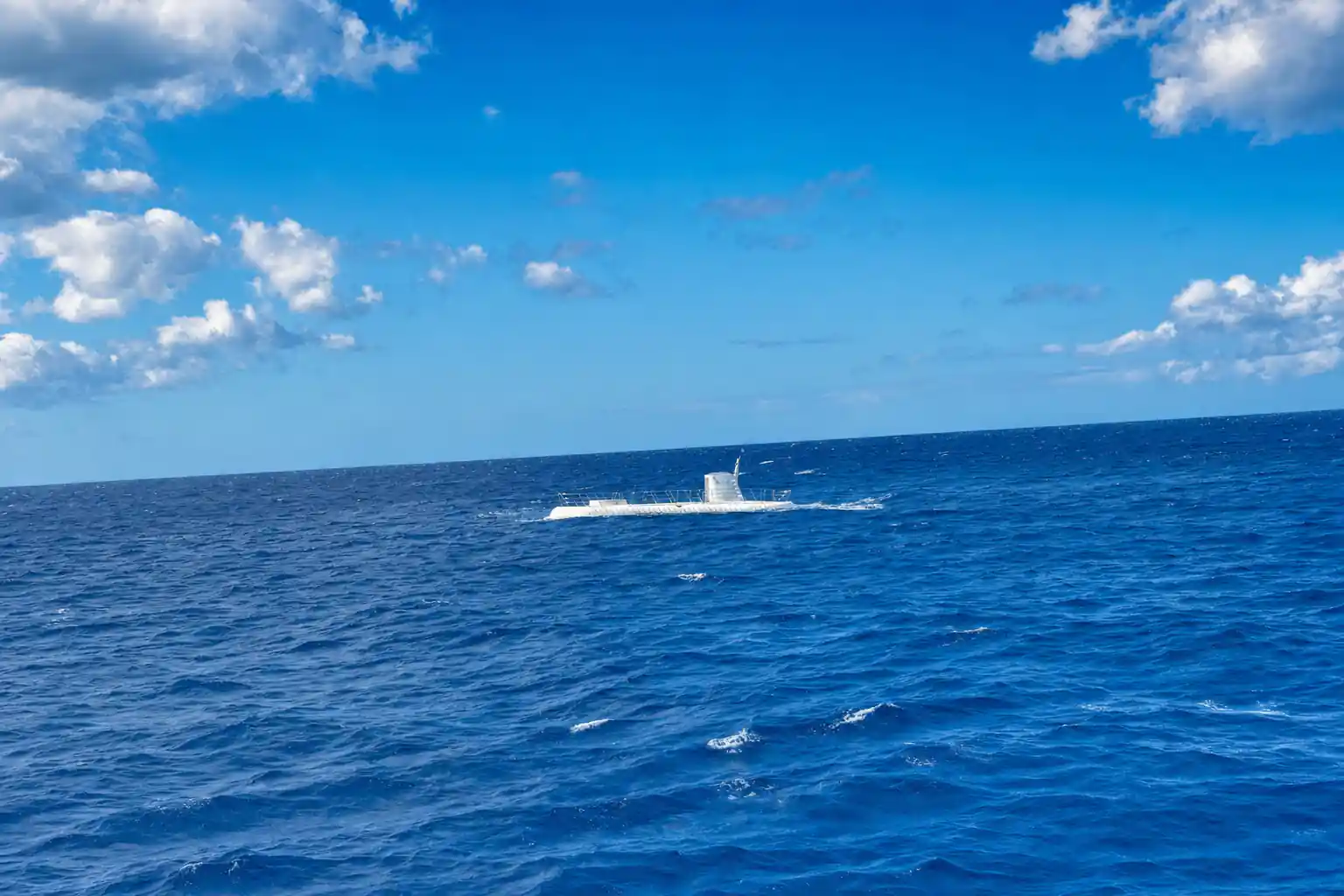
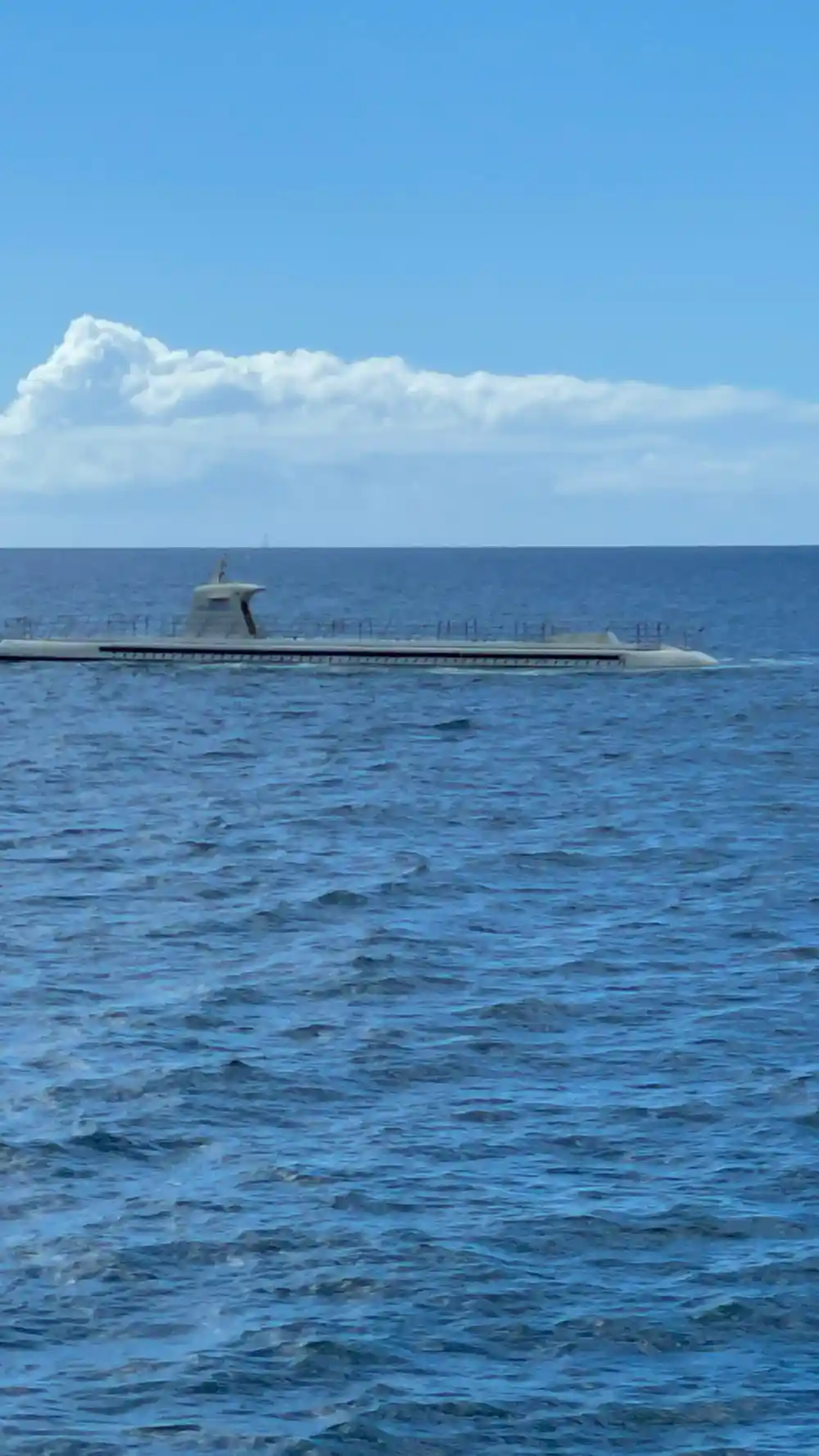
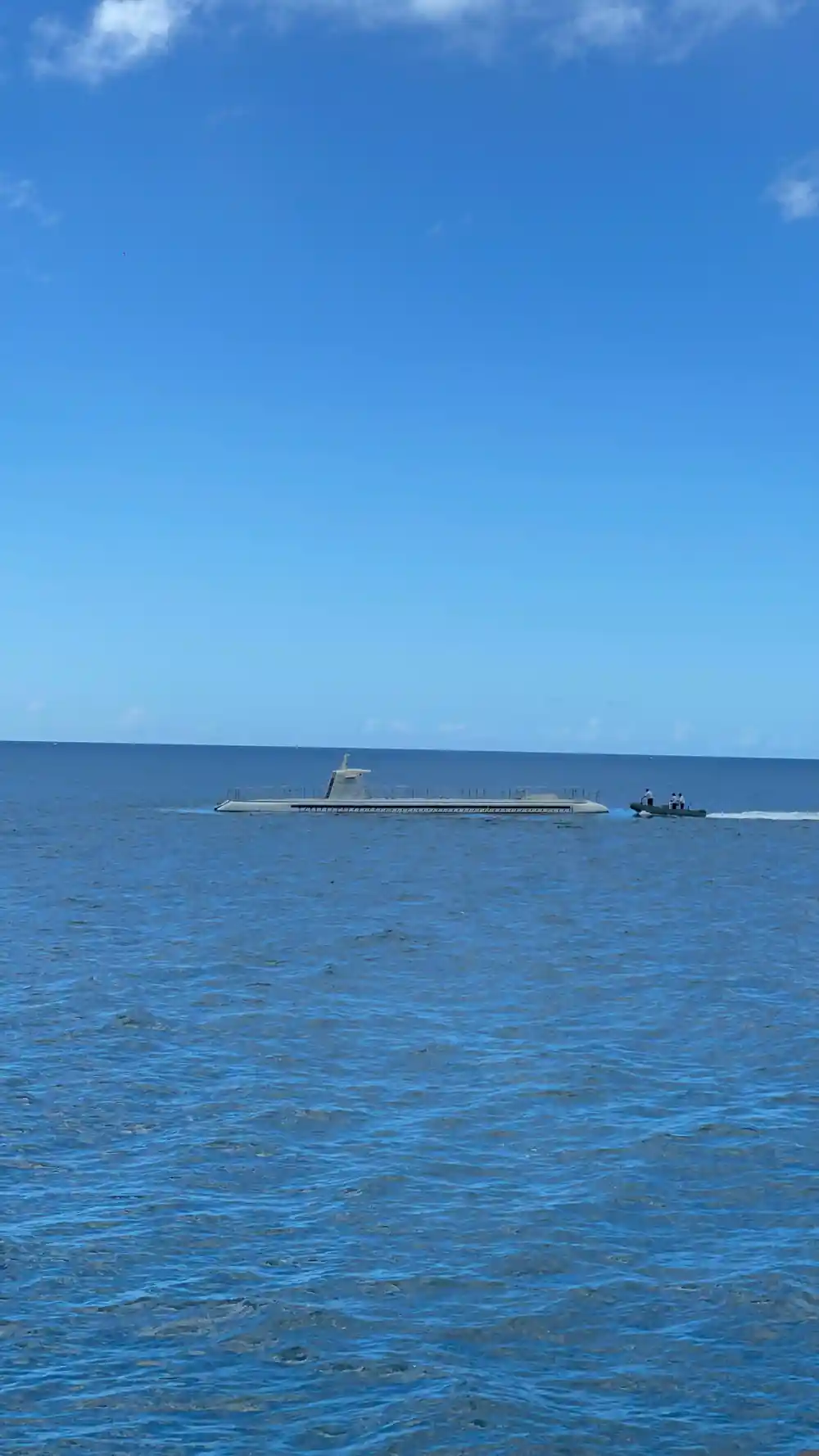
The submarine is moored offshore and surfaces to receive you, so the ladder is reached from the deck of a surface boat that comes alongside.
That means there are two transitions rather than one: boat to submarine casing, then casing down the ladder into the cabin. Both are supervised and both are quick, and the sea is normally sheltered enough that neither is dramatic.
Boarding sixty-four people takes a few minutes and is done in an orderly sequence, which is part of why check-in is twenty minutes before the advertised time.
At the end the whole thing runs in reverse, and by then you have done it once and know exactly what it involves.
If somebody in your group cannot do it
This comes up often enough to answer directly, because it usually surfaces when a family is booking for several people and one of them is uncertain.
Find out before you book, not at the pier. A phone call or a message to the operator describing the specific limitation will get you a straight answer, and they would far rather have that conversation in advance than turn somebody away on a boat offshore.
If the answer is no, it is worth knowing that this constraint is unusual rather than typical. A great many Hawaiian boat trips - catamaran sails, whale watching, glass-bottomed boats - have step-free or near step-free boarding, and a glass-bottomed boat in particular offers a version of the same idea with none of the access problem.
And if the answer is borderline, the honest framing is the one above: the question is not whether you can get down at the start, it is whether you can climb out comfortably at the end of an hour and three quarters.
Seven steps, unaided, both ways
from US$168Reserve now & pay later
Questions people ask
How do you board the submarine?
How steep is it?
Is there help?
What if I cannot manage it?
Why can't they build a better entrance?
Is getting out the same?
What should I wear?
How long does boarding take?
Boarding, step by step
Check in at the pier
Twenty minutes before the scheduled time, at the Hilton Pier.
Board the surface boat
It ferries you out; the submarine stays offshore.
Come alongside
The submarine surfaces and the boat comes to it. Both are supervised.
Step across onto the casing
The first of two transitions, and the one where hands should be free.
Down through the hatch
Face the ladder, both hands on the rails, seven steps, backwards.
And the same in reverse
Coming up is easier than going down, because you can see where you are going.