The quick version
- Which is the opposite of what makes a space feel closed.
- The cabin never leaves one atmosphere, so there is no bodily reminder.
- A bright room with an aisle, not a crawlspace full of pipes.
- You cannot leave mid-dive, and that is the honest caveat.
The most-asked question about any submarine
It comes up before depth, before marine life, before anything. People imagine being sealed in a metal tube under a hundred feet of water and quite reasonably want to know how that feels.
The answer, for the overwhelming majority of passengers, is that it does not feel like the thing they were imagining at all, and there are concrete reasons why rather than reassurance.
It is also worth separating two different worries that get given the same name: not wanting to be in a small space, and not wanting to be somewhere you cannot leave. This vessel handles the first extremely well and the second not at all, and knowing which one you have makes the decision straightforward.
Why the space does not feel small
Claustrophobia is largely triggered by visual and spatial cues: enclosure with no sightline out, low ceilings, walls close on multiple sides, dim light.
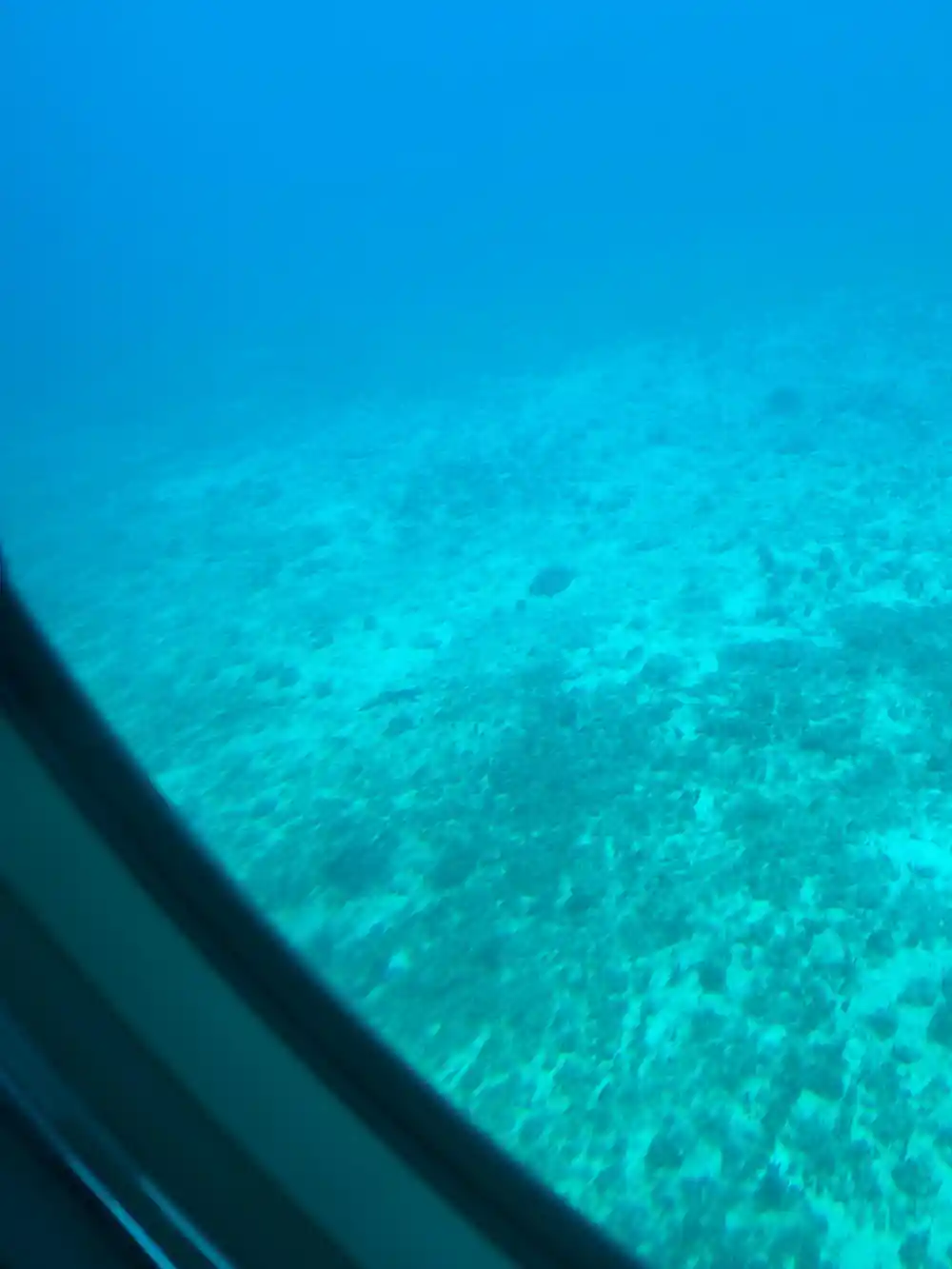
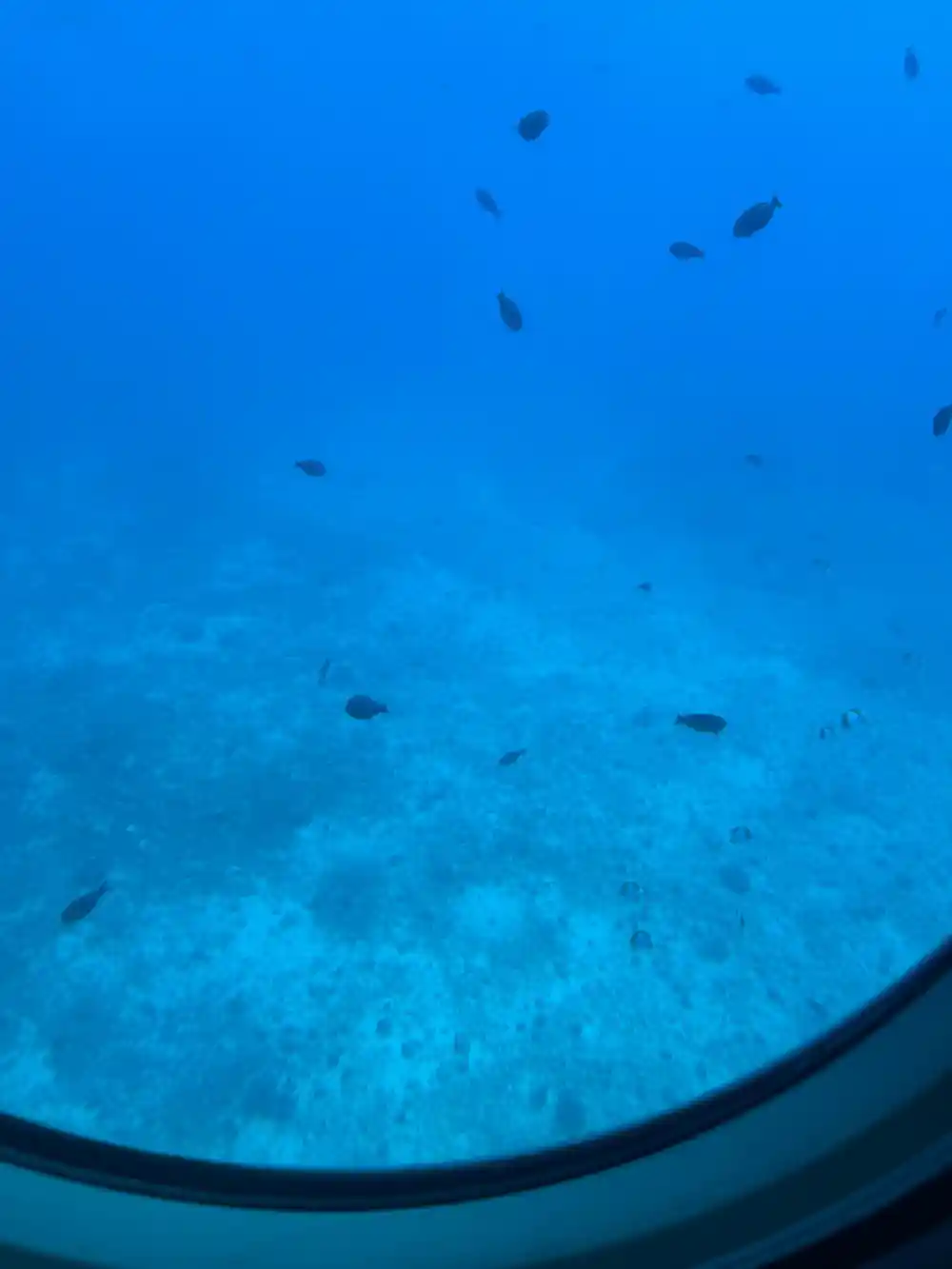
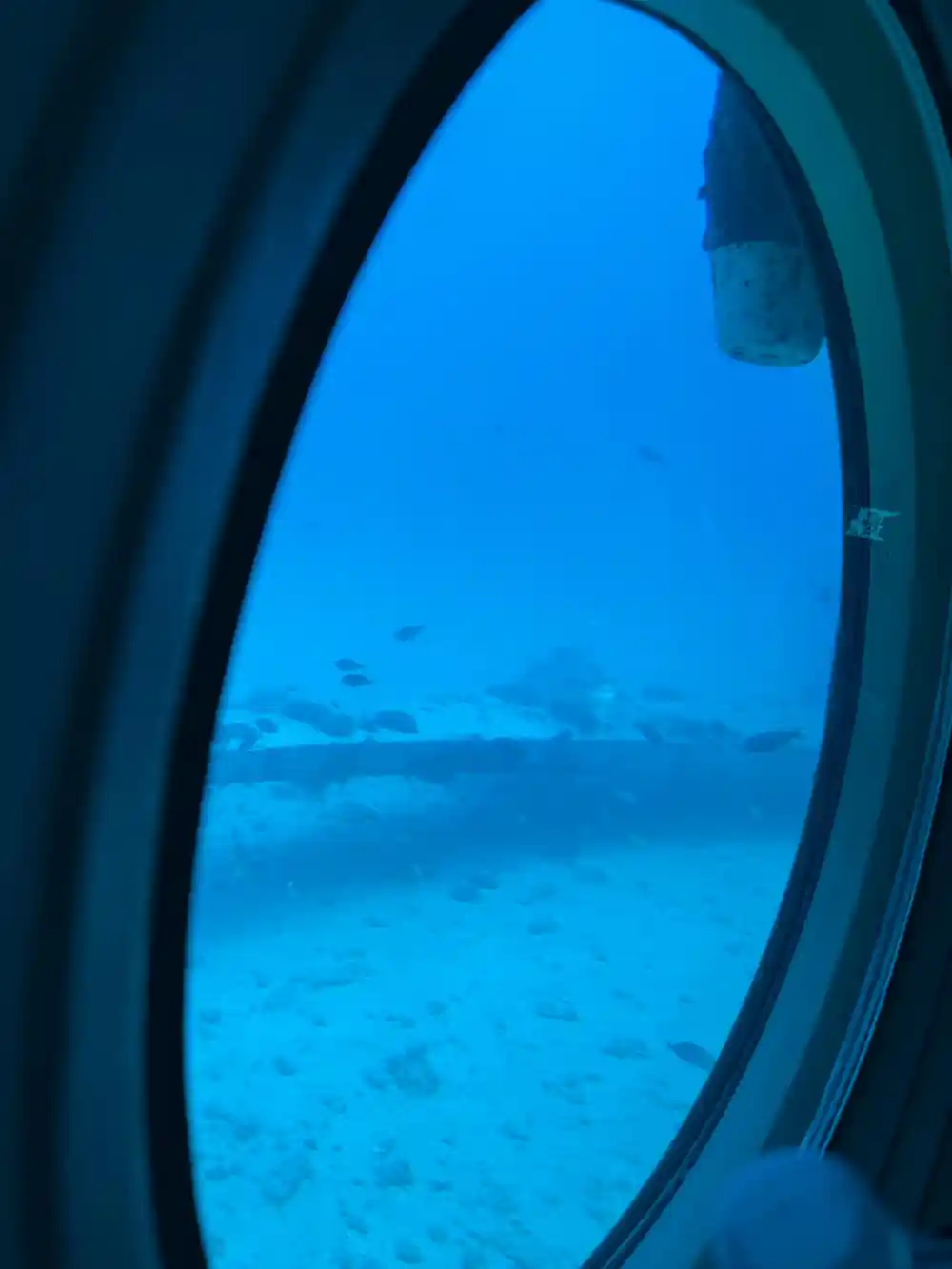
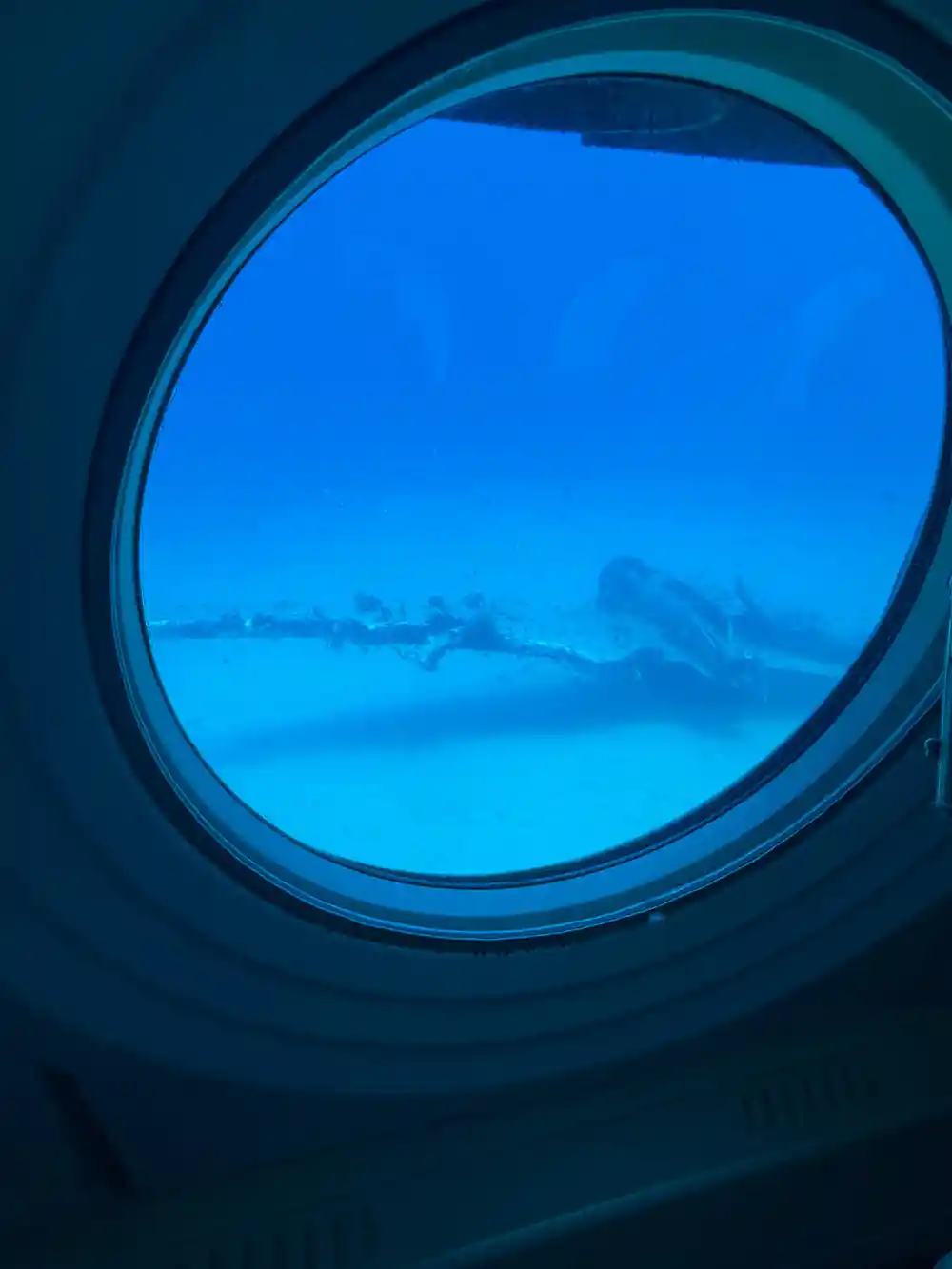
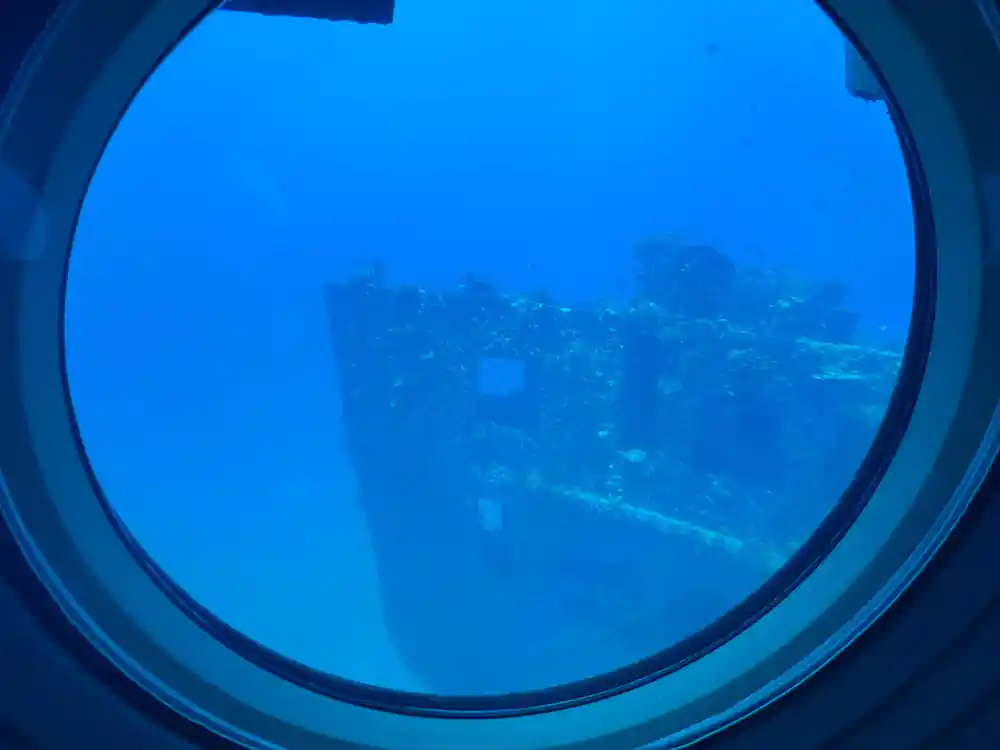
The cabin removes almost all of them. Every seat faces a large round viewport, so every passenger has a view of open water and, at this depth, daylight. That is not a porthole to peer through; it is a window directly in front of you for the entire dive.
The seating is back to back down the centre, which means nobody is boxed in by other people and nobody is facing a wall. The aisle is clear. The lighting is bright and white rather than dim and red. The ceiling is higher than the mental image of a submarine allows for.
The overwhelming reaction on descending the ladder is that it is roomier than expected, and people who arrived braced for a tube frequently forget to be nervous.

Daylight through a viewport at depth
The absence of physical cues
This is the second half of it and it is less obvious.
In most situations that provoke anxiety about enclosure there is a bodily signal reinforcing it: pressure on the ears in a lift or an aircraft, heat, closeness of air, a sense of movement. Those signals tell the nervous system that something unusual is happening, and the mind supplies the interpretation.
Here there are none. Cabin pressure never leaves one atmosphere, whatever depth the hull reaches, so your ears register nothing. It is air-conditioned and dry rather than warm and close. The motion is slow and smooth, and once submerged there is no wave movement at all, which makes the submarine substantially stiller than the boat that brought you.
The result is a set of senses reporting that you are sitting in a cool bright room, while your eyes report a shipwreck outside the window. That combination is far more likely to produce delight than panic.
The honest caveat
It is a sealed vessel, offshore, and it cannot be left in the middle of a dive.
For somebody with a serious diagnosed claustrophobia, that is the fact that matters, and no amount of viewports changes it. If the thing you cannot tolerate is the impossibility of leaving rather than the size of the room, this trip contains that in an irreducible form.
The dive is short - the submarine portion is the middle section of an hour and three quarters - which helps. But it is not a few minutes.
The right approach for anybody genuinely uncertain is a conversation with the operator before booking. This is a question they field all the time; they know their own boat, and they would much rather field it before you book.
1 atm
The cabin never leaves surface pressure, so there is no equalising, no popping and no bodily signal that anything unusual is happening.
If it does bother you on the day
Say so, immediately and out loud, to a crew member. They are trained for it, they have seen it, and nobody makes anything of it.
The practical things that help are all available. Look out of the window rather than around the cabin, because the sightline is the thing doing the work. Slow your breathing deliberately. Talk to whoever you are with. Ask the commentator a question, which is a remarkably effective way of redirecting attention.
Ask about surfacing if you genuinely need to. Any decision about the dive belongs to the pilot and depends on where the boat is and what else is happening, and the crew will tell you what is possible.
The thing not to do is to endure it silently. A short conversation early is a much better outcome than an hour of quietly enduring, and everybody aboard would rather you had the first.
What people actually report
The most common comment from passengers who worried about this beforehand is some version of surprise: that it was bigger than expected, that they forgot to be anxious, that the window made all the difference.
The second most common is about the stillness. People braced for a claustrophobic experience often find that the submerged part of the trip is the calmest section of it, and considerably calmer than the boat ride out.
And a good number of people who would never dive, never snorkel and dislike open water do this specifically because it removes everything they find frightening about the sea while leaving what they want to see. For that group the vessel is not the obstacle. It is the entire point.
A window at every seat, and nothing happens to your ears
from US$168Reserve now & pay later